

Most of an attacker’s fantasy points are not goals and assists. They are the small stuff, the key passes and shots and crosses and dribbles that each score a point or two and stack up every week. A team produces a mountain of that small stuff, and it produces it in a particular way. The chances themselves get created by whipping a cross in, by beating a man on the dribble, or by threading a key pass through the middle. Read which, and you know which of a manager’s players is banking the points.
How each manager builds an attack
Crossing and dribbling are the two habits that separate managers cleanly. They barely move with how good the attack is, so they describe style, not quality. Plot every manager on those two axes, size each dot by how much his team threads the ball through the middle (its key passes, the third habit), and this season’s managers sort out like this, each at his most recent season.
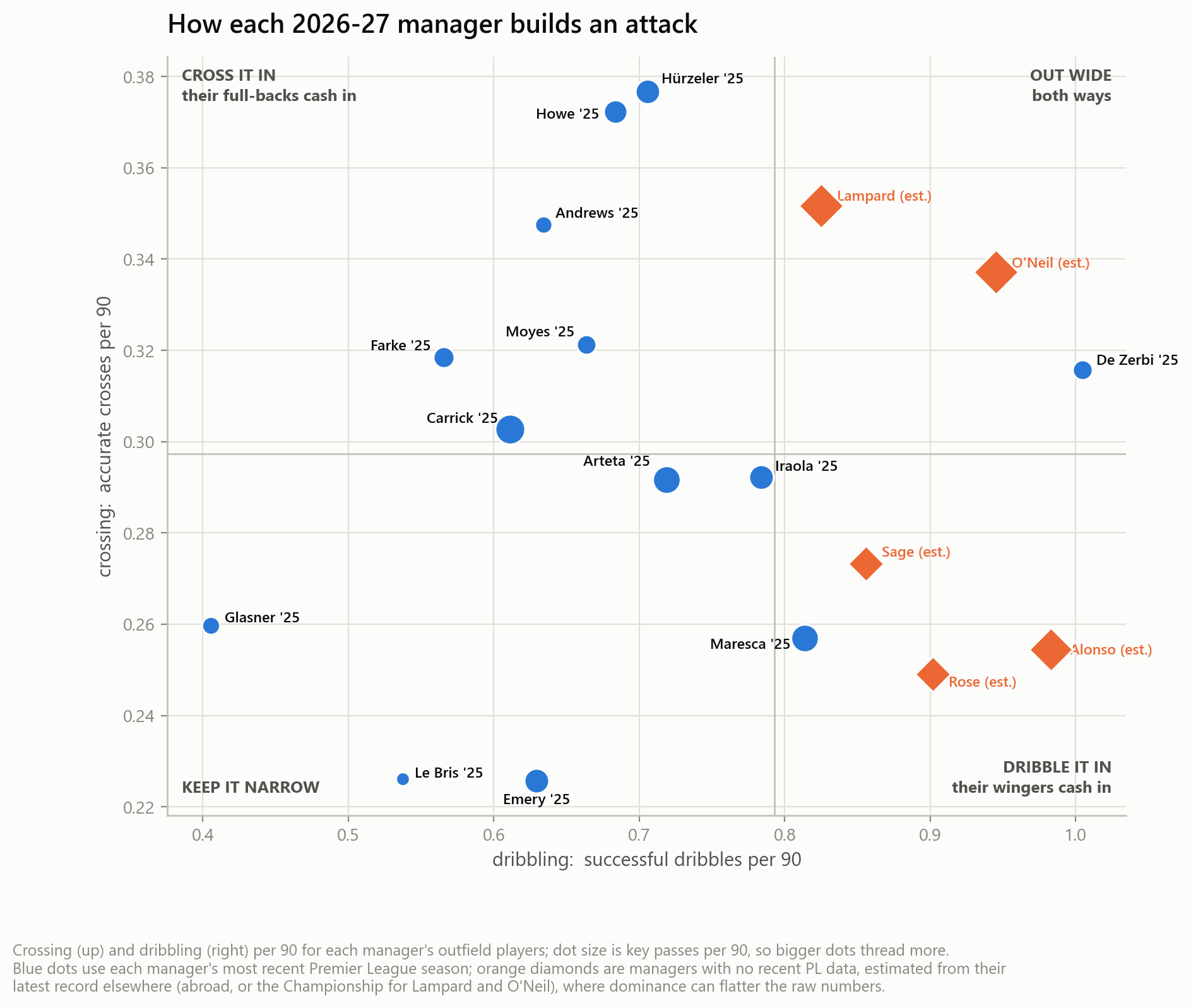
The honest picture is that most of them cluster: a modern Premier League attack is a bit of everything. But the edges are the tell. Fabian Hürzeler’s Brighton and Keith Andrews’ Brentford cross the most. Unai Emery’s Aston Villa barely cross at all, working narrow and central. Roberto De Zerbi’s Tottenham get it out wide both ways. The biggest dots, Michael Carrick’s United and Mikel Arteta’s Arsenal, thread it through the middle most, feeding a central creator rather than a man out wide. Now look at the quadrant labels: each one names the player that style quietly feeds. Cross it in and the full-backs cash in; dribble it in and the wingers do. That is the tell worth drafting on.
The same map, but for players
Those quadrant labels are a claim. Here is the proof, on the very same axes: drop every attacking role where its own crossing and dribbling put it, and each one lands in a corner.
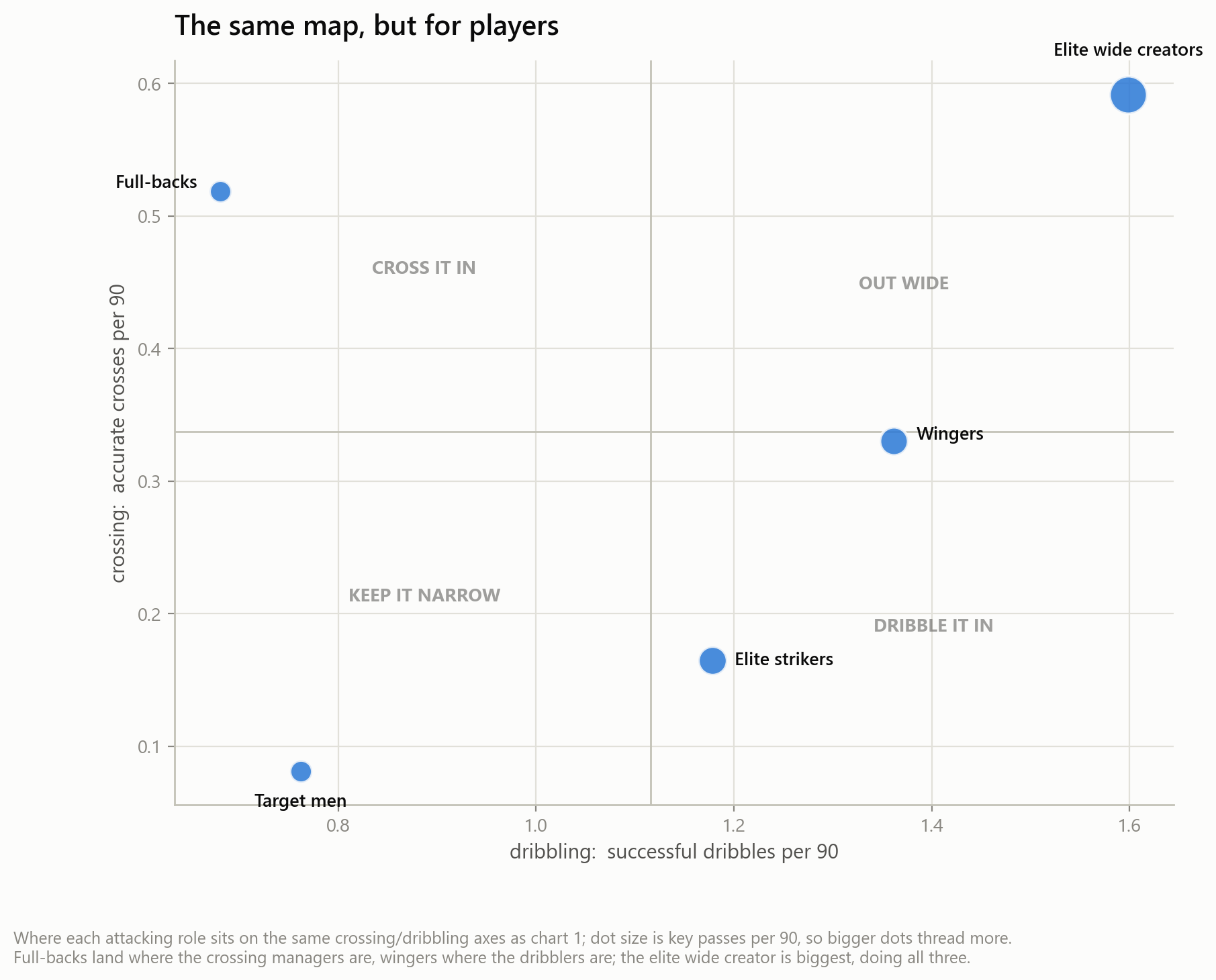
Full-backs sit in the CROSS corner, exactly where the crossing managers are. Wingers and out-and-out strikers sit in the DRIBBLE corner, with the dribblers. Target men keep it narrow. The elite wide creator sits out wide and is the biggest dot of all, doing a bit of everything, which is why he is worth a pick under any manager. The one role these two axes cannot place is the central creator, the attacking midfielder: his trick is the key pass through the middle, the third way to build an attack, and the possession clubs are built around him.
So the two charts are one picture. Find your manager’s corner on the first, read off the role sitting in the same corner on the second, and that is the player his system quietly feeds: a crossing manager’s full-back, a dribbling manager’s winger, a threading side’s central creator. And that full-back is not only a clean-sheet pick, he is a chance-creation pick too, drafted late because everyone else takes full-backs for the shut-out alone.
The managers you have to estimate
Seven of this season’s managers have no recent Premier League form to read. Five can still be placed as estimates, the orange diamonds. Xabi Alonso’s Leverkusen and then his Real Madrid barely crossed, threaded a pile of key passes and carried it on the dribble, so expect a Chelsea that feeds its central creators and its wide dribblers, not its full-backs. Marco Rose is a Klopp-schooled transition coach whose Bournemouth will dribble and counter more than cross. Pierre Sage’s Lyon were untilted, a bit of everything. Frank Lampard and Gary O’Neil come up from the Championship, where their Coventry and Ipswich sides crossed hard and created plenty; dominating a weaker league flatters the raw numbers, but the lean, wide and direct, should carry.
The last two read from reputation. Álvaro Arbeloa’s Fulham should press and keep the ball, an attacking, creation-first side. Sergej Jakirović’s Hull sound compact and defend-first, which in fantasy terms means thin attacking returns, the sort of side whose attackers you mostly leave alone. An estimate is a prior, not a promise, but it beats a shrug.
Who to draft
Threading sides (Arteta at Arsenal, Maresca at Man City, De Zerbi at Tottenham, Iraola at Liverpool, Carrick at Man Utd) feed their central creators, the key-pass machines:
Bruno Fernandes, Declan Rice, Dominik Szoboszlai, Phil Foden. (Chelsea’s Alonso is a new-manager estimate, so his creators sit in the section below.)
Crossing sides (Hürzeler at Brighton, Andrews at Brentford, Howe at Newcastle, Moyes at Everton, Farke at Leeds, Lampard at Coventry) hand cheap points to two roles nobody reaches for:
Full-backs: Jake O’Brien and Vitalii Mykolenko (Everton), Michael Kayode (Brentford), Gabriel Gudmundsson and Jayden Bogle (Leeds), Lewis Hall and Valentino Livramento (Newcastle), Mats Wieffer (Brighton).
Target men: Dominic Calvert-Lewin (Leeds), Kevin Schade (Brentford), Thierno Barry and Beto (Everton).
Dribbling sides (Rose at Bournemouth) are thin this year, and thin on standout wingers, but the wide man who beats his defender is the pick. (O’Neil’s Ipswich now lean wider than dribble, and have no draftable Premier League history yet.)
Elite wide creators cash in anywhere:
Bukayo Saka, Mohamed Salah, Jeremy Doku, Bryan Mbeumo, Florian Wirtz, Rayan Cherki, Cody Gakpo.
Where the fit is still a guess
There is no avoid list of good players. A good player in a settled side scores whatever his manager’s style, and if he is staying put under the manager he already thrived under, nothing here changes that. Style only warns you when the system is new. For 2026-27 that means four clubs with a new manager and an established squad: Chelsea (Xabi Alonso), Bournemouth (Marco Rose), Crystal Palace (Pierre Sage), and Fulham (Álvaro Arbeloa). Every player there is drafted on what he did under a different boss, and the new man’s style is only an estimate, so the move is to discount the style-dependent upside, not to avoid.
Bournemouth’s cross-heavy full-back under a counter-coach. Adrien Truffert projects as a top-ten asset partly on his overlapping, cross-heavy game, but Rose’s sides dribble and break rather than work the byline. If the crosses go, so does a chunk of that ceiling.
Fulham’s overlapping full-backs under a possession coach. Antonee Robinson, Kenny Tete and Timothy Castagne are valued for bombing on; Arbeloa’s Fulham should keep the ball and invert, asking them to hold, not fly. Alex Iwobi, the central creator, is the safer bet on that team.
Palace’s marauder into the unknown. Daniel Munoz goes early, around pick 17, for his overlapping runs, but Sage’s Lyon were untilted, so whether that license survives the new man is anyone’s guess.
At Chelsea it cuts the other way. Alonso’s estimate leans threading and dribbling, so his central creators, Enzo Fernandez and Cole Palmer, and his wide runners, Pedro Neto and new signing Morgan Rogers, are the safest fits among the newcomers. The wilder bet is his wing-backs, the role Frimpong and Grimaldo turned into an auxiliary-forward gold mine at Leverkusen. Reece James has drifted central since his injuries and Malo Gusto is only a maybe, so the wide berths likely fall to the summer signings, Marco Palestra and the teenage left-back Denner, who carry no Premier League record to project yet. Whether they cash in comes down to whether Alonso imports that Leverkusen shape or the more orthodox one from his Real Madrid year. A manager’s style tells you who cashes in, but at these four clubs the style itself is still a guess, so treat the fits as bets, not reads.
The rule to carry into your draft: the manager tells you which of his players will quietly pile up points. Read how he builds an attack, then draft the man his system feeds.
Premier League 2020-21 to 2025-26, all outfield players, league matches only. “Crossing” is accurate crosses per 90, “dribbling” is successful dribbles per 90, “threading” is key passes per 90; all three are Fantrax-scored. Crossing and dribbling are the style axes because they barely track how much a team attacks. This season’s foreign arrivals are placed by their style within their own league, mapped onto the Premier League scale and marked as estimates; two arrivals with no data in a covered league are read from their reputation. Every manager shown handled at least 200 player-appearances, and the player rosters are as the draft board has them. Where the avoid list cites the draft market, that is average draft position on early 2026-27 boards, set against this projection’s own rank. These are the stats players actually produced under each manager; the 2026-27 calls apply that history forward, so treat them as leans, not locks.