

Sean Dyche builds teams that scrap near the bottom of the table. Pep Guardiola builds the best side in the country. Yet across the last six seasons, Dyche’s defenders have scored more fantasy points per game than Guardiola’s.
That is not a fluke, and it is not really about clean sheets. It is about what a defender actually does out there. In Fantrax a defender banks points for tackles, interceptions, clearances, blocks and headers won, not just for the shut-out. The manager decides which of those his defenders get to rack up, and that turns out to matter more than the club badge.
Which managers’ defenders score the most
Line up every manager by how many fantasy points his defenders produce, and the top is not the list you would guess. Jürgen Klopp leads, and the elite clean-sheet sides are up there with him. But so are Dyche, Oliver Glasner and Régis Le Bris, whose clubs spend most of the season fighting relegation.
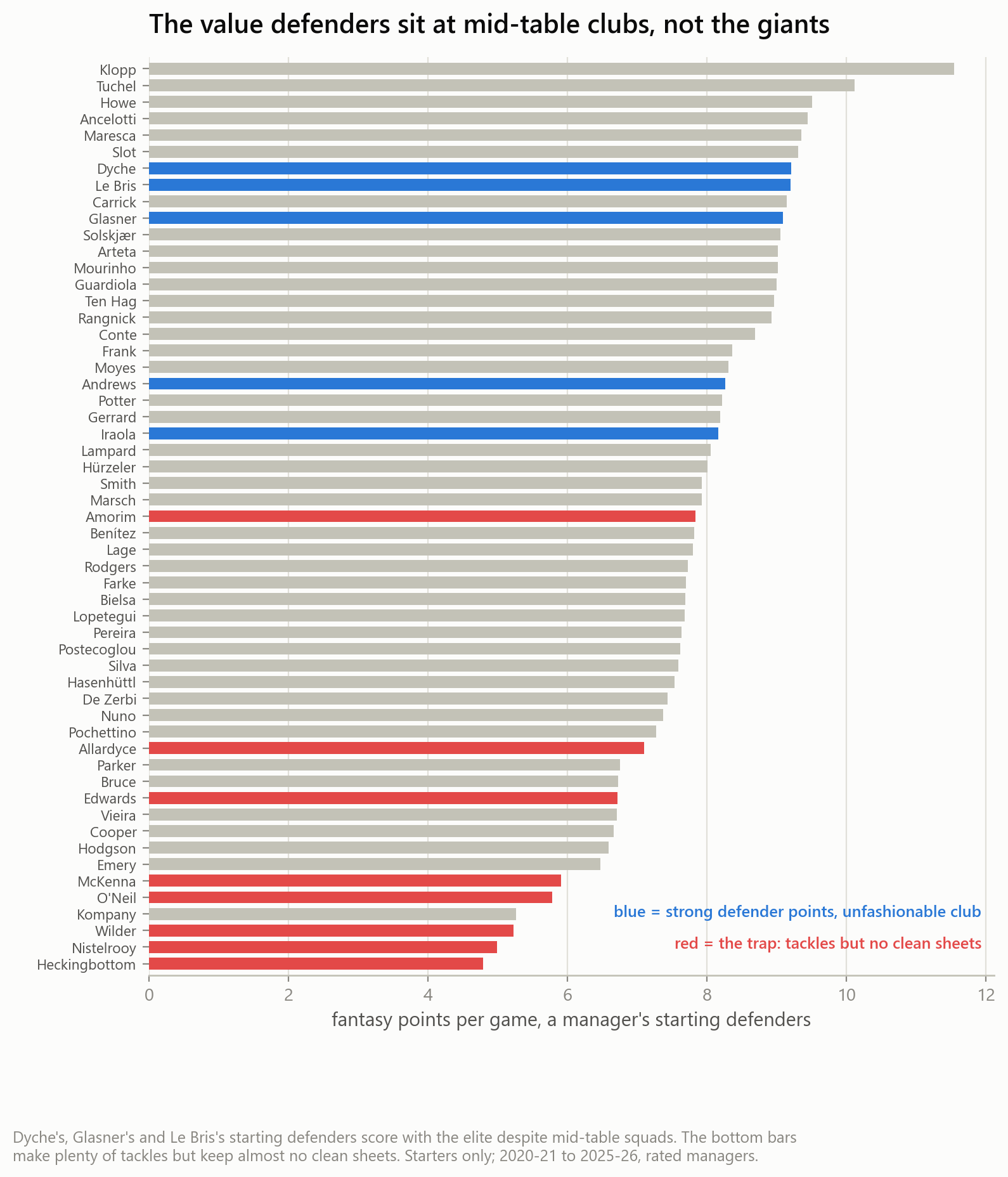
The blue names are the tell. Dyche, Glasner and Le Bris run mid-table or promoted sides, and their defenders score right alongside the giants’. The red names are the warning, and we will come back to them.
It comes down to the kind of defender
The reason is the type of defender each manager sends out. Split every Premier League defender by the role he plays, count only the seasons he genuinely started, and two things separate the types: how high the ceiling goes, and how many of each are actually worth drafting.
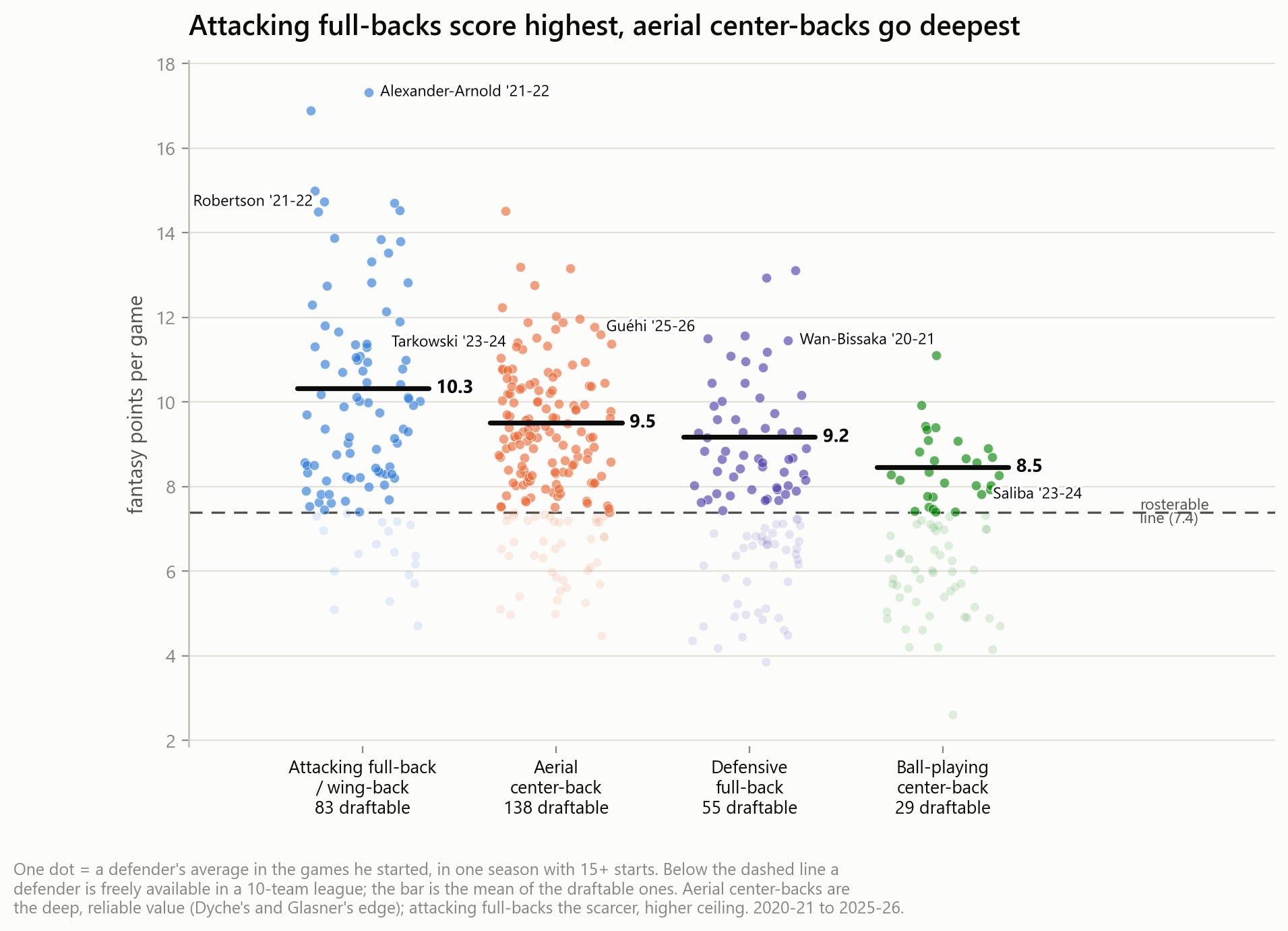
Attacking full-backs and wing-backs have the highest ceiling, but there are not many. When one hits, he is the best fantasy defender on the board. A Trent Alexander-Arnold or a prime Kieran Trippier plays so high up that he scores like a midfielder, assists and key passes stacked on top of the clean sheet, and lands near the top of the whole chart. Among genuine starters they score highest of any type. But only about eighty were worth rostering across six seasons, fewer than the aerial center-backs, and the group runs from those league-winners down to full-backs who barely start. The elite ones are worth reaching for. The rest are coin-flips, and you cannot count on landing one.
Aerial center-backs are the deep, reliable value. A James Tarkowski or an Ethan Pinnock wins headers, clears his lines and throws himself in front of shots, again and again. Every one of those is a fantasy point, and they pile up whether or not the clean sheet arrives. The group is high-floored and deep: clearer the rosterable line than any other type, and they fill about half of the top thirty defenders every season. Miss one in the draft and there is another on the waiver wire. This is Dyche’s and Glasner’s edge, and the one you can rely on. Tarkowski scored more fantasy points at Everton than Virgil van Dijk did at Liverpool, simply because he did more.
Defensive full-backs sit a rung below. Play deeper and stay wide, do more defending and less creating, and the attacking returns dry up. A few still score well off clean sheets and defensive work, but fewer clear the rosterable line, and the group averages more than a point below the attacking full-backs.
The elegant ball-playing center-back is the thinnest at the top. William Saliba and Marc Guéhi are fine footballers who keep clean sheets, but starting attacks does not show up in a box score. Fewer than thirty were worth rostering across six seasons, the fewest of any type. The clean sheet is most of what they give you, and a clean sheet on its own is worth less than a clean sheet plus a mountain of headers and blocks.
That is the whole story. Guardiola’s defense is built on ball-players who keep clean sheets. Dyche’s is built on aerial bruisers who keep some clean sheets and do a pile of other stuff besides. In a format that counts the other stuff, the bruiser wins, and he wins reliably.
The trap at the bottom
Now those red names. Chris Wilder, Kieran McKenna and Paul Heckingbottom ran sides whose defenders make plenty of tackles and clearances, and they score the fewest fantasy points of any managers in the league.
The culprit is the missing clean sheet. Their teams sat deep and defended for their lives but conceded anyway, keeping a shut-out in fewer than one game in ten. Defensive actions are worth a little each. A clean sheet is worth a lot. Rack up the actions but never keep the shut-out and the points just do not add up. Do not chase a big tackle count at a team that ships goals.
Isn’t this just squad quality?
Half of it, yes. Guardiola’s and Tuchel’s defenders keep clean sheets because their teams are excellent, and everyone at your draft already knows to take the elite-club defender. That is why he goes early.
The half squad quality does not explain is the type of defender a manager fields. A stat-hoovering aerial center-back at a mid-table club is not on a great team, and he still out-scores the ball-player at a great one. That is a system choice, and the edge you can actually use.
So who do you draft?
For reliable points, aerial center-backs at organized deep-defending clubs. The Tarkowski profile, under a Dyche, Glasner or Le Bris. High floor, few duds, and the deepest pool on the board, so you never have to reach. This is the value pick.
For upside, the elite attacking full-back in a forward-pushing system. The Alexander-Arnold, prime-Trippier profile. When it hits it is the best defender on the board, clean sheets plus midfielder-level attacking returns. But the good ones are scarce and go early, and the rest are coin flips, so only reach for one you believe in.
Be cautious with the ordinary full-back. The deeper, defend-first full-back scores more than a point below the attackers once you set the elite aside.
Be wary of the fashionable ball-playing center-back at a giant. He keeps clean sheets and does little else. Fine, not special.
Avoid the tackle-monster at a leaky team. All of the defensive work, none of the clean sheets, low points.
The rule to carry into your draft: a defender’s fantasy value is set by his manager’s system, and the system that wins turns defenders into stat machines. More often than not, that is an organized mid-table side, not a possession-heavy giant.
Premier League 2020-21 to 2025-26, league matches only. Scoring is a defender’s mean Fantrax points in the games he started (60 or more minutes). Playing-style types come from an on-pitch-role classifier; full-backs are split into attacking and defensive by how far up the pitch they average. The type chart shows one dot per season a player started at least 15 times, with the rosterable line at roughly the fiftieth-best defender each season, about replacement in a 10-team league. Every manager shown handled at least 200 player-appearances. These are the points defenders actually produced, a description of where the points came from rather than a claim about coaching.