

When Tottenham sacked Nuno Espírito Santo and hired Antonio Conte in November 2021, their players gained more than 2 fantasy points a game. When Chelsea swapped Thomas Tuchel for Graham Potter, they had no change. Both are ordinary outcomes, and neither is a reason to cut a good player.
First, the scope: this is about sackings during a season, and only those. A summer appointment cannot be measured this way, because the squad turns over across the break and you can never tell the new manager apart from the new signings. Sack a man in November and the players on either side of the swap are near enough the same people, which is the only honest way to ask what the change itself did. There have been 36 of those since 2020.
A permanent hire is a small nudge up, a caretaker a small nudge down
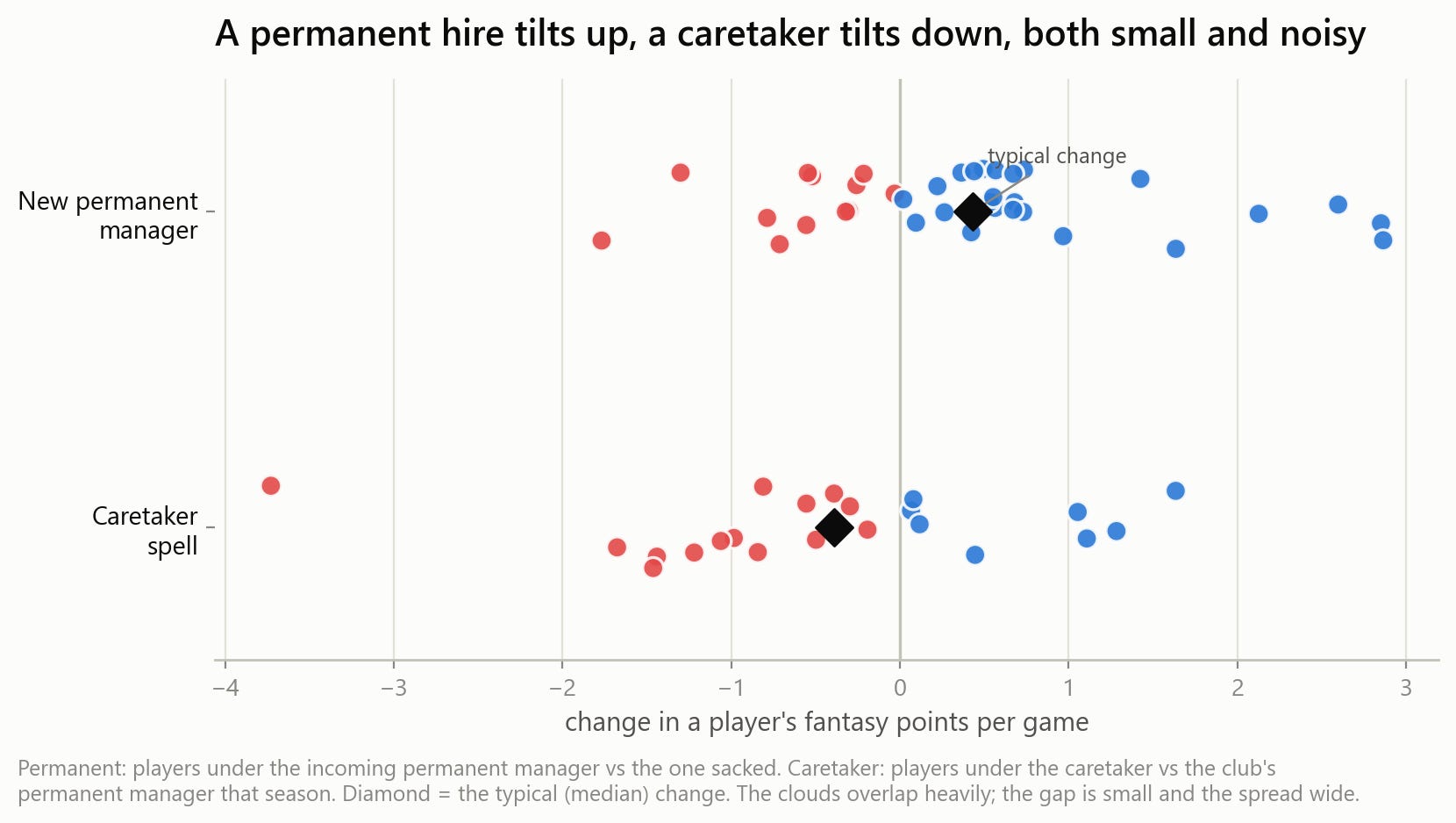
Bring in a proper replacement and the players tend to score a little more: 66% ticked up, and the typical move is under 0.5 points a game. Hand the team to a caretaker instead and it leans the other way by a little less.
Then look at how far the two clouds overlap. Both leans are small, and in either group plenty of players went the other way. The sacking on its own is not the story.
So which of your players will improve?
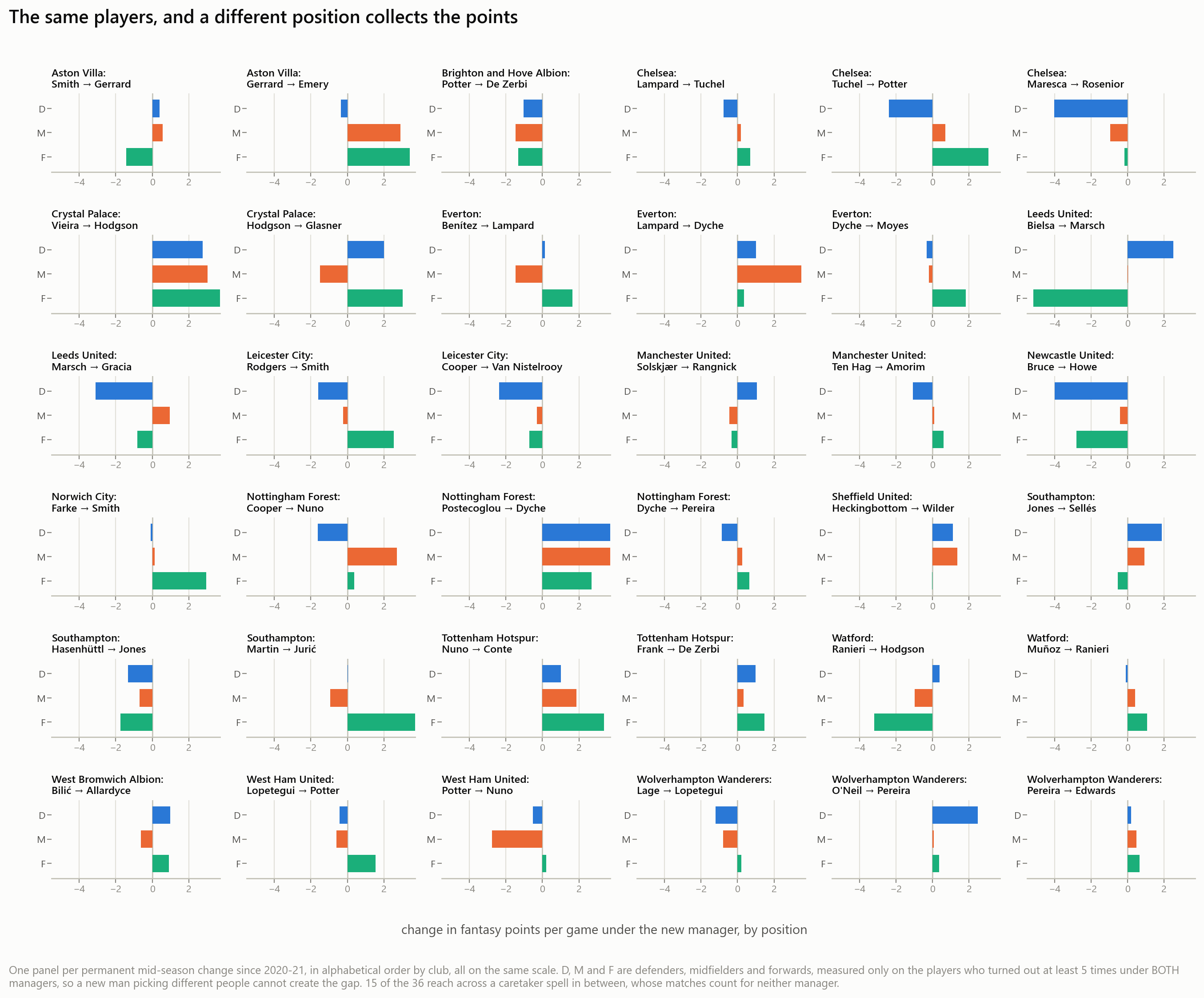
Leeds is the clearest case: Bielsa to Marsch left the squad almost exactly where it was as a group, while the defenders were up 2.5 a game and the forwards down 5.2. Chelsea’s Tuchel to Potter is the mirror, and even flatter as a group: the same defenders down 2.4, the same forwards up 3.1. At Nottingham Forest, Cooper to Nuno was worth 2.7 a game to the midfielders and cost the defenders 1.6. Newcastle is the one to watch out for: their players averaged more under Eddie Howe than under Steve Bruce, but the men who were there for both scored less in every position, because that improvement arrived in the January window rather than from the dugout.
Read the new manager, not the sacking
So the question is never “is the new guy good?” It is “where was the old one leaking points, and does the new one plug that hole?” Both halves are knowable on the day of the appointment. You already know which part of your player’s team has been bad, because you have been watching it all autumn, and managers do not change what they believe on the way to a new club: a defense-first coach pours points into the back half of the team, a wing-back system pays the full-backs, a front-foot setup pays the forwards.
Look at where the two meet. At Leeds, Bielsa’s football asked his defenders to attack and it was costing them: they were scoring 2.8 a game below what a Premier League defender averages, the worst department in his team. Marsch came in and the defenders gained 2.5 while the forwards gave back 5.2. At Aston Villa, Gerrard had every group below the league line and the attack worst of all at 1.9 down; Emery arrived and lifted the midfield 2.9 and the forwards 3.4. At Nottingham Forest, Cooper’s weakest department was his midfield at 1.8 below the line, and Nuno’s arrival was worth 2.7 a game to exactly that group.
Chelsea is the version that costs you money. Tuchel’s defenders were 2 points a game above the line, the best thing about that team, and his attack was 1.3 below it. Potter arrived and did what Potter does: the forwards gained 3.1 and the defenders handed back 2.4. If you were holding a Chelsea center-back, the sacking was the sell signal, and everyone else in your league was still looking at the clean sheets.
Two honest notes. A club sacks its manager because results have gone bad, so part of any lift is a bad run ending rather than a better coach: the sacked man’s spell was running about 0.75 a game below what his club had managed the season before, and his replacement claws back only about half of that. And the best squads score well whoever is in charge. This is about the shuffle inside a club, not about turning a bad team into a good one.
So, buy, hold or drop?
If a caretaker has the dugout for a fortnight, do nothing. The dip is slight and it is noisy, and it is nowhere near big enough to cut a good player over. Hold him, keep starting him, and wait for the permanent appointment, which is the thing that actually matters.
If a permanent manager is coming in, do two pieces of homework. First, work out which part of that team has been bad, because that is the hole the club just paid to fill. Second, look up how the new man plays. Where those two answers meet is your pickup: the full-back at a club whose defense has been leaking, about to inherit a wing-back system; the striker at a club that has not scored, about to get a manager who actually plays one; the holding midfielder about to start racking up tackles for a defense-first boss. Your league-mates are all staring at last season’s totals, which were produced under a different coach and are about to be worth a couple of points a game more, or less, to somebody on that roster. Watch the first 3 or 4 games to confirm which way it went, then claim him before the rest of your league notices.
Premier League 2020-21 to 2025-26, league matches only, scored on Fantrax rules. Mid-season changes only, with the club and season held fixed, so the players are near enough the same on both sides of the swap; a manager appointed between seasons cannot be measured this way and none are included. 36 permanent handovers qualify, each manager having taken charge of at least 5 matches; where a caretaker sat between two permanent managers the handover still counts and the caretaker’s matches belong to neither man. The caretaker cloud in the first chart holds 23 spells, at whatever length each one lasted. The positional figures, and the club figure they are compared against, use only players with at least 5 appearances under each manager. Whether a manager’s style lets you call the move in advance is not something 36 sackings can settle, and only 13 of the incoming managers had a Premier League record to read beforehand; the named examples are descriptions of what happened, not a tested forecast. These are the points players actually produced under each manager, not a prediction of what any single change will do next.